Jodie Clark
Where the Crawdads SingJodie Clark is Kya Clark’s older brother and one of the few members of her family to return after leaving the marsh. His departure leaves Kya alone with their violent father; years later, his return restores a sibling bond but cannot undo the childhood abandonment that shaped her life.
Identity and Return
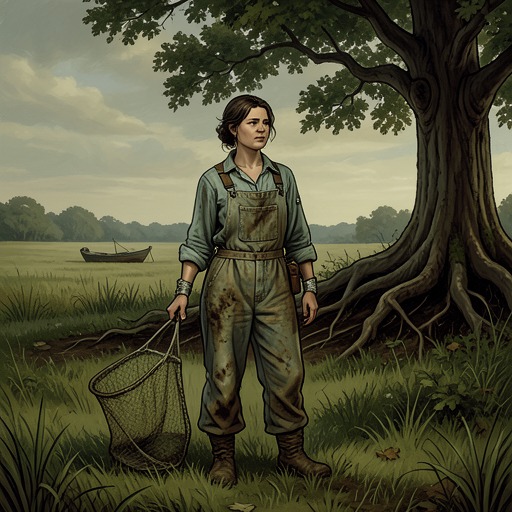
When Jodie appears on Kya’s porch as an adult, she recognizes him by the crooked scar on his face. The sight opens a buried memory: as children, she had found him bloodied and apparently dead on the floor, while their mother stitched his face with a sewing needle. Kya had run into the woods afterward, throwing her bonnet into the saw grass. In the present, the old scar and the memory of blood return together, showing how much of her family history had been pushed out of conscious recollection. Though Jodie moves toward her, Kya hangs her head and backs away; he steps onto the porch rather than forcing an embrace. Their reunion begins not with easy affection but with the distance left by fear and time.
Jodie acknowledges that he left Kya in the care of their abusive father and calls himself a coward. He says that his military medals mean nothing beside the fact that he abandoned a little girl to survive alone. Kya answers that he was a child too, but Jodie insists that he could have come back when he was older. His remorse does not erase the harm; it makes explicit that he has carried the choice with him for years.
He explains that after leaving, he survived on Atlanta’s back streets with only seventy-five cents, taken from the money their father had left in the kitchen. Odd jobs kept him going until the Army accepted him; after training, he went to war. When he returned, he assumed Kya had left as well, and he says that he did not write. He describes reenlisting as a form of self-punishment for what he had done. Only after graduating from Tech did he see a book by Catherine Danielle Clark in a shop and realize that Kya might still be found. He came back to the marsh to look for her, turning the book that marked her independent life into the trail that led him home.
Family, Loss, and Reunion
Jodie’s return reconnects Kya with one brother but cannot reassemble the family that scattered from the marsh. When she asks about Ma and the other children, he admits that he knows nothing of Murph, Mandy, or Missy and would not recognize them if they passed him in the street. Then he tells Kya that Ma died two years earlier. The news makes his arrival both a reunion and a belated messenger’s visit: he has found Kya, but he cannot restore the mother or siblings whose absence defined her childhood.
He brings something that changes the shape of that absence. In the back of his pickup, beneath a tarp, is a box of oil paintings Rosemary sent him. Jodie unwraps them one by one and sets them around the truck bed: one shows Kya and her sisters crouched beside the lagoon watching dragonflies; another shows Jodie and their brother holding up a string of fish. Ma had painted the children for years, day and night. A further picture gathers all five siblings as if they were looking back at their mother, and Kya studies the faces of the family she had lost. The paintings do not undo the separation, but they give material form to a connection that distance and silence had obscured: Ma continued to picture her children together.
Before leaving, Jodie tells Kya to find Tate, whom he considers a good man. He promises to stay in touch, send his address when he moves, and return when he can; Kya asks him to visit. His red pickup disappears down the lane, leaving her crying and laughing at once. The exchange closes his return without pretending that one visit can repair every absence: he has delivered painful news, carried evidence of their mother’s enduring attention, and left Kya with a path toward the life she has built beyond her family.
Memory, Violence, and Belated Recognition
The reunion also changes how Jodie figures in Kya’s long years alone. In the charged moment of seeing him again, she imagines him beside her through the marsh, showing her paths and teaching her repeatedly about Herons and Fireflies. This is not a report that he had secretly returned; it is a way the narrative gives shape to the brother she had wanted back, whose knowledge and companionship seem to join the natural world that sustained her. The imagined presence makes the reunion more than a recovery of the past: it reveals how longing can persist even when memory has buried its source.
Jodie’s account of their father resists turning that history into a simple excuse. He says he had seen the side of their father that could be kind, but that he always returned to drinking; he also connects the drinking to the war, drawing on his own experience of war and its damaging effects. Yet he insists that suffering did not justify taking it out on a wife and children. His judgment recognizes the possible roots of the violence without softening its consequences for the family, keeping responsibility in view alongside regret.
Jodie and the Story Told About Kya
Jodie’s return offers a family perspective that stands against Barkley Cove’s public mythology of Kya. At her trial, Tom Milton describes how villagers called her the Marsh Girl, repeated extravagant rumors about her, and rejected an abandoned child instead of offering food or clothes; Jumpin’ was one of the few people who helped. Jodie’s confession makes the family’s part in that abandonment personal, while his return shows that the label never captured the whole story. The contrast matters: the town had treated Kya’s isolation as proof that she was strange, when it was also the consequence of people leaving her without care.